
Mar 1:16 Now as he walked by the sea of Galilee, he saw Simon and Andrew his brother casting a net into the sea: for they were fishers.
Mar 1:17 And Jesus said unto them, Come ye after me, and I will make you to become fishers of men.
Joh 21:15 So when they had dined, Jesus saith to Simon Peter, Simon, son of Jonas, lovest thou me more than these? He saith unto him, Yea, Lord; thou knowest that I love thee. He saith unto him, Feed my lambs.
Joh 21:16 He saith to him again the second time, Simon, son of Jonas, lovest thou me? He saith unto him, Yea, Lord; thou knowest that I love thee. He saith unto him, Feed my sheep.
Joh 21:17 He saith unto him the third time, Simon, son of Jonas, lovest thou me? Peter was grieved because he said unto him the third time, Lovest thou me? And he said unto him, Lord, thou knowest all things; thou knowest that I love thee. Jesus saith unto him, Feed my sheep.
Joh 21:18 Verily, verily, I say unto thee, When thou wast young, thou girdedst thyself, and walkedst whither thou wouldest: but when thou shalt be old, thou shalt stretch forth thy hands, and another shall gird thee, and carry thee whither thou wouldest not.
Joh 21:19 This spake he, signifying by what death he should glorify God. And when he had spoken this, he saith unto him, Follow me.
Amos 7:14 (KJV)
14 Then answered Amos, and said to Amaziah, I was no prophet, neither was I a prophet's son; but I was an herdman, and a gatherer of sycomore fruit
Who was this Amaziah?
Then Amaziah the priest of Bethel,.... The Targum calls him the prince or president of Bethel; and the word used signifies both a prince and a priest; and very probably this man had the care of the civil as well as religious matters in Bethel. Aben Ezra styles him the priest of Baal; he was one that succeeded the priests that Jeroboam the son of Nebat placed here, to offer sacrifices to the calf he set up in this place, 1Ki 12:32; who hearing the above three visions of Amos delivered, and fearing that he would alienate the people from the idolatrous worship he was at the head of, and frighten them from an attendance on it, which would lessen his esteem with the people, and also his worldly gain and profit; and observing that Amos did not make any intercession for the averting of the judgment threatened in the last vision, as in the other two, and which particularly concerned the king's family: Gill
He sounds much like those who we see Paul encountering in the Book of Acts. Paul was another who received this direct specific call....
Act 9:2 And desired of him letters to Damascus to the synagogues, that if he found any of this way, whether they were men or women, he might bring them bound unto Jerusalem.
Act 9:3 And as he journeyed, he came near Damascus: and suddenly there shined round about him a light from heaven:
Act 9:4 And he fell to the earth, and heard a voice saying unto him, Saul, Saul, why persecutest thou me?
Act 9:5 And he said, Who art thou, Lord? And the Lord said, I am Jesus whom thou persecutest: it is hard for thee to kick against the pricks.
Act 9:6 And he trembling and astonished said, Lord, what wilt thou have me to do? And the Lord said unto him, Arise, and go into the city, and it shall be told thee what thou must do.
Act 9:13 Then Ananias answered, Lord, I have heard by many of this man, how much evil he hath done to thy saints at Jerusalem:
Act 9:14 And here he hath authority from the chief priests to bind all that call on thy name.
Act 9:15 But the Lord said unto him, Go thy way: for he is a chosen vessel unto me, to bear my name before the Gentiles, and kings, and the children of Israel:
Act 9:16 For I will shew him how great things he must suffer for my name's sake.
Amo 1:1 The words of Amos, who was among the herdmen of Tekoa, which he saw concerning Israel in the days of Uzziah king of Judah, and in the days of Jeroboam the son of Joash king of Israel, two years before the earthquake.
The words of Amos,.... Not which he spoke of or for himself, but from the Lord; all the prophecies, visions, and revelations made unto him, are intended:
who was among the herdsmen of Tekoa; which was not in the tribe of Asher, as Kimchi; nor of Zebulun, as Pseudo-Epiphanius (i); but in the tribe of Judah, 2Ch 11:5. It lay to the south, and was six miles from Bethlehem. Mr. Maundrell (k) says it is nine miles distant, to the south of it; and, according to Jerom (l), it was twelve miles from Jerusalem; though he elsewhere (m) says, Thecua, or Tekoa, is a village at this day, nine miles from Aelia or Jerusalem, of which place was Amos the prophet, and where his sepulchre is seen: either there is a mistake of the number, or of Aelia for Bethlehem; the former rather seems to be the case; according to Josephus (n), it was not far from the castle of Herodium. The Misnic doctors (o) speak of it as famous for oil, where the best was to be had; near to it was a wilderness, called the wilderness of Tekoa; and Jerom (p) says, that beyond it there was no village, nor so much as huts and cottages, but a large wilderness, which reached to the Red sea, and to the borders of the Persians, Ethiopians, and Indians, and was full of shepherds, among whom Amos was; whether he was a master herdsman, or a servant of one, is not said. The word is used of the king of Moab, who is said to be a "sheepmaster", 2Ki 3:4; he traded in cattle, and got riches thereby; and so the Targum here renders it,
"who was lord or master of cattle;''
and Kimchi interprets it, he was a great man among the herdsmen; and so it was a piece of self-denial to leave his business, and go to prophesying; but rather he was a servant, and kept cattle for others, which best agrees with Amo 7:14; and so is expressive of the grace of God in calling so mean a person to such a high office. The word used signifies to mark; and shepherds were so called from marking their sheep to distinguish them, which seems to be the work of servants; and, in the Arabic language, a kind of sheep deformed, and of short feet, are so called:
which he saw concerning Israel; or, against Israel (q), the ten tribes, to whom he was sent, and against whom he prophesied chiefly; for he says very little of Judah. Words are more properly said to be spoken or heard; but here they are said to be seen; which shows that not bare words are meant, but things, which the prophet had revealed to him in a visionary way, and he delivered; see Isa 2:1;
in the days of Uzziah king of Judah; who was also called Azariah, 2Ki 15:1;
and in the days of Jeroboam the son of Joash king of Israel; so he is called to distinguish him from Jeroboam the son of Nebat; this king was the grandson of Jehu; he was, as Jerom says, before Sardanapalus reigned over the Assyrians, and Procas Sylvius over the Latines:
two years before the earthquake; which was well known in those times, and fresh in memory. Zechariah speaks of it many years after, from whom we learn it was in the days of Uzziah, Zec 14:5. The Jewish writers generally say that it was when Uzziah was smote with leprosy for invading the priest's office; and was in the year in which he died, when Isaiah had a vision of the glory of the Lord, and the posts of the house moved, Isa 6:1; and with whom Josephus (r) agrees; who also relates, that the temple being rent by the earthquake, the bright light of the sun shone upon the king's face, and the leprosy immediately seized him; and, at a place before the city called Eroge, half part of a mountain towards the west was broken and rolled half a mile towards the eastern part, and there stood, and stopped up the ways, and the king's gardens; but this cannot be true, as Theodoret observes; since, according to this account, Amos must begin to prophesy in the fiftieth year of Uzziah; for he reigned fifty two years, and he began his reign in the twenty seventh year of Jeroboam, 2Ki 15:1; who reigned forty one years, 2Ki 14:23; so that Uzziah and he were contemporary fourteen years only, and Jeroboam must have been dead thirty six years when it was the fiftieth of Uzziah; whereas they are here represented as contemporary when Amos began to prophesy, which was but two years before the earthquake; so that this earthquake must be in the former and not the latter part of Uzziah's reign, and consequently not when he was stricken with the leprosy.
(i) De Vita Prophet. c. 12. (k) Journey from Aleppo to Jerusalem, p. 88. (l) Proem. in Amos & Comment. in Jer. vi. 1. (m) De locis Hebr. in voce Elthei, fol. 91. B. (n) De Bello Jud. l. 4. c. 9. sect. 5. (o) Misn. Menachot, c. 8. sect. 3. (p) Proem. in Amos. (q) על ישראל "contra Israelem", so some in Drusius. (r) Antiqu. l. 9. c. 10. sect. 4.
I'm curious about the history of this earthquake...
I am reposting this very interesting account fro CRI.


The Scientific and Scriptural Impact of Amos' Earthquake
by Steven A. Austin, Ph.D. *
The Bible is often regarded as a book of stories based on a primitive people's understanding of the world around them. As such, many people--and even some Christians--believe that it is not a reliable source of history. But science continues to prove them wrong.
 An Ancient Earthquake
The Kings of Israel and Judah ruled during the period of time designated as the Iron Age by archaeologists. Widely separated archaeological excavations in the countries of Israel and Jordan contain late Iron Age (Iron IIb) architecture bearing damage from a great earthquake.1 Masonry walls best display the earthquake's effects, especially those with broken ashlars or displaced rows of stones, walls that are still standing but are leaning or bowed, and collapsed walls with large sections still lying course-on-course.
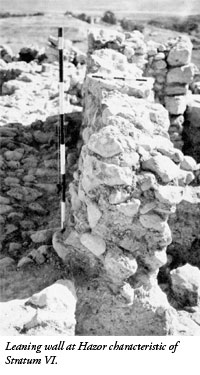
Earthquake evidence is seen prominently at Hazor, Israel's largest ancient city. In excavations beginning in 1955 by archaeologist Yigael Yadin, twenty-two successive cities were discovered to have been built on top of each other.2 Excavations in Hazor's Stratum VI revealed tilted walls, inclined pillars, and collapsed houses. In the Iron Age building called "Ya'el's House" within Stratum VI, objects of daily use were found beneath the fallen ceiling. General southward collapse within Stratum VI argues that the earthquake waves were propagated from the north. After more than 50 years of excavations at Hazor, earthquake damage continues to be revealed in even some of the strongest architecture.
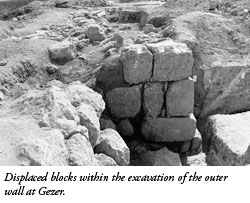
The city of Gezer was also severely shaken. The outer wall of the city shows hewn stones weighing tons that have been cracked and displaced several inches off their foundation. The lower part of the wall was displaced outward (away from the city), whereas the upper part of the wall fell inward (toward the city) still lying course-on-course.3 This indicates that the wall collapsed suddenly.
A Magnitude 8 Event
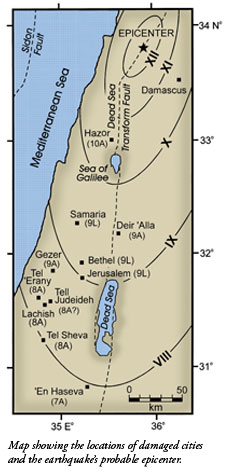
Earthquake debris at six sites (Hazor, Deir 'Alla, Gezer, Lachish, Tell Judeideh, and 'En Haseva) is tightly confined stratigraphically to the middle of the eighth century B.C., with dating errors of ~30 years.4 So, the evidence points to a single large regional earthquake that occurred about 750 B.C. The accompanying map displays the site intensity (Modified Mercalli Intensity from archaeology or literature) and lines of equal intensity of shaking (isoseismals).
 The epicenter was clearly north of present-day Israel, as indicated by the southward decrease in degree of damage at archaeological sites in Israel and Jordan. The epicenter was likely in Lebanon on the plate boundary called the Dead Sea transform fault. A large area of the ancient kingdoms of Israel and Judah was shaken to inflict "general damage" to well-built structures (what is called Modified Mercalli Intensity 9 or higher). The distance from the epicenter (north of Israel) to the region of "significant damage" to well-built structures (what is called Modified Mercalli Intensity 8 that is south of Israel) was at least 175 kilometers, but could have been as much as 300 kilometers.
Using the pattern and the intensity of damage through the region of the earthquake, the earthquake's magnitude can be estimated. Through a process known as scaling, the damage areas of smaller historic earthquakes of known magnitude are used to scale upward to estimate the area of damage and magnitude of the regional earthquake. Based on this method, the earthquake in question was at least magnitude 7.8, but more likely was 8.2.5 This magnitude 8 event of 750 B.C. appears to be the largest yet documented on the Dead Sea transform fault zone during the last four millennia. The Dead Sea transform fault likely ruptured along more than 400 kilometers as the ground shook violently for over 90 seconds! The urban panic created by this earthquake would have been legendary.
Scriptural References
In the mid-eighth century B.C., a shepherd-farmer named Amos of Tekoa de livered an ex tra ordinary speech at the Temple of the Golden Calf in the city of Bethel in the northern kingdom of Israel just "two years before the earthquake" (Amos 1:1). Uzziah was king of Judah and Jeroboam II was king of Israel. Amos spoke of the land being shaken (8:8), houses being smashed (6:11), altars being cracked (3:14), and even the Temple at Bethel being struck and collapsing (9:1). The prophet's repeated contemporary references to the earthquake's effects is why it bears his name.
Amos' Earthquake impacted Hebrew literature immensely.6 After the gigantic earthquake, no Hebrew prophet could predict a divine visitation in judgment without alluding to an earthquake. Just a few years after the earthquake, Isaiah wrote about the "Day of the Lord" when everything lofty and exalted will be abased at the time when the Lord "ariseth to shake terribly the earth" (Isaiah 2:19, 21). Then, Isaiah saw the Lord in a temple shaken by an earthquake (Isaiah 6:4).
 Joel repeats the motto of Amos: "The Lord also will roar out of Zion, and utter his voice from Jerusalem," and adds the seismic theophany imagery "the heavens and the earth shall shake" (Joel 3:16; compare Amos 1:2). After describing a future earthquake and panic during the "Day of the Lord" at Messiah's coming to the Mount of Olives, Zechariah says, "Yea, ye shall flee, like as ye fled from before the earthquake in the days of Uzziah king of Judah" (Zechariah 14:5). The panic caused by Amos' Earthquake must have been the topic of legend in Jerusalem, because Zechariah asked his readers to recall that terrifying event 230 years later.
The author of Hebrews asks us to keep in mind the coming cosmic shakedown that will finally usher in the future "kingdom which cannot be moved" (Hebrews 12:28). In light of God's marvelous promises to those who believe, "let us have grace, whereby we may serve God acceptably with reverence and godly fear."
References
- Austin, S.A., G. W. Franz, and E. G. Frost. 2000. Amos's Earthquake: An extraordinary Middle East seismic event of 750 B.C. International Geology Review. 42 (7): 657-671.
- Yadin, Y. 1975. Hazor, the rediscovery of a great citadel of the Bible. New York: Random House, 280 pp.
- Younker, R. 1991. A preliminary report of the 1990 season at Tel Gezer, excavations of the "Outer Wall" and the "Solomonic" Gateway (July 2 to August 10, 1990). Andrews University Seminary Studies. 29: 19-60.
- Austin et al, Amos's Earthquake.
- Austin et al, Amos's Earthquake.
- Ogden, K. 1992. The earthquake motif in the book of Amos. In Schunck, K., and M. Augustin, eds., Goldene apfel in silbernen schalen.Frankfurt am Main: Peter Lang, 69-80; Freedman, D.N., and A. Welch. 1994. Amos's earthquake and Israelite prophecy. In Coogan, M.D., J. C. Exum, and L. E. Stager, eds., Scripture and other artifacts: essays on the Bible, and archaeology in honor of Philip J. King. Louisville, KY: Westminster John Knox, 188-198.
* Dr. Austin is Senior Research Scientist and Chair of the Geology Department.
Cite this article: Austin, S. 2010. The Scientific and Scriptural Impact of Amos' Earthquake. Acts & Facts. 39 (2): 8-9.

Please write your Comments here!:
Post a Comment